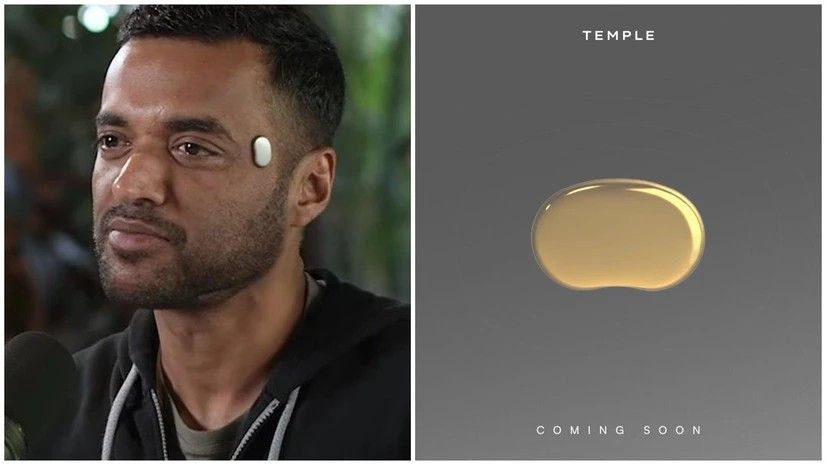
In early January 2026, a moment in a podcast caught global attention — Deepinder Goyal, the CEO and co-founder of Zomato and Eternal, appeared on the Raj Shamani “Figuring Out” podcast wearing a small, mysterious gadget clipped to the side of his head. What started as a curiosity quickly ballooned into something much bigger: speculation, memes, expert criticism, and widespread debate about the nature of the device, now being called Temple.
Here’s everything we currently know about this elusive device.
What Temple Actually Is
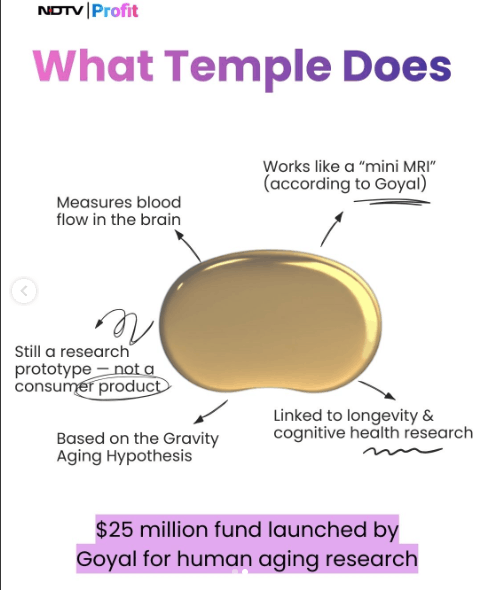
The device seen on Goyal’s temple is described in multiple reports as an experimental wearable designed to monitor cerebral blood flow in real time. Unlike conventional smartwatches or fitness trackers, Temple is meant to provide continuous data on how blood circulates through the brain — a key physiological metric linked with brain health, ageing, and neurological function.
According to media accounts, the core scientific idea behind Temple centers on what has been called the **“Gravity Ageing Hypothesis” — a concept Goyal has mentioned in public comments that explores how cerebral blood flow might be affected by posture, movement, and gravity over time.
Deepinder Goyal himself has been personally involved in testing the device for nearly a year, wearing it during everyday activities and discussing it casually in public — which is what first sparked widespread curiosity.
Temple Is Still Experimental — Not for Sale
One critical point repeatedly emphasized by Deepinder Goyal is that Temple is not a commercial product and is not currently available for purchase. In multiple public posts on social media platform X, Goyal has clarified that:
- There has been no public commercial announcement of Temple.
- No official benchmarking data has been released.
- The device remains in an experimental stage, months away from any preview or potential launch.
- If and when Temple becomes a product, scientific and clinical data will be shared first.
This means that much of the speculation — including claims that it is already a verified health-monitoring gadget — is premature.
What Temple Is Supposed to Do
Reports suggest Temple is intended to:
- Continuously measure blood flow and oxygenation in the brain
- Be worn on the head’s temple region for real-time data
- Offer insights into cerebral circulation during daily life (e.g., while sitting, walking, or upright)
- Potentially contribute to research on ageing and neurological health
The goal is to provide non-invasive monitoring of a physiological parameter typically assessed with complex medical imaging — such as MRI, CT perfusion, or ultrasound — which currently requires clinical environments.
If successful, such continuous metrics could one day feed into personalised health insights or early detection of issues related to ageing or cognitive decline — but that remains theoretical at this phase.
The Scientific Debate and Skepticism
While the idea is intriguing to many in the tech community, experts in neurology and medicine have been cautious or critical. Notable responses include:
- Criticism from AIIMS medical professionals, who have questioned Temple’s scientific backing and pointed to a lack of peer-reviewed clinical evidence supporting its claims. Some doctors have described the device as a “toy” with no established medical value as currently configured.
- Calls for rigorous validation and clinical trials before any serious health claims can be made.
Medical experts stress that while cerebral blood flow is a real and important metric in stroke, dementia, and other neurological conditions, validated clinical tools for these measurements remain the standard for now. Wearables like Temple may offer new data streams, but they are not yet replacements for medically approved diagnostics.
Why Temple Sparked Such Curiosity
Before Temple became a topic of discussion, most viewers expected an ordinary business or leadership interview with the Zomato founder. Instead, attention quickly shifted to the small metallic clip-like device on his head, prompting wide speculation — from clever tech trend to possible sci-fi innovation.
The mystery around Temple’s purpose, combined with Goyal’s willingness to wear it publicly long before any formal launch or explanation, created a perfect viral moment. On social platforms, the device was joked about, analysed, and debated extensively — often outpacing serious discussion of its scientific potential.
Interestingly, tech founders and early-stage investors have described the concept as “wild and fascinating,” underscoring how cutting-edge experimental tech often straddles the line between innovation and speculation.
What We Still Don’t Know
Despite all the buzz, several key questions remain because Temple is still a prototype:
- Does it reliably measure what it claims in real-world use?
- Will it receive regulatory approval as a medical device?
- Will data from Temple be clinically actionable?
- When, or if, it will become available to consumers?
The developer has said that more science and data will be shared before any launch, and that skepticism is welcome — but at the appropriate stage.
Final Word
Temple remains one of the more unusual and talked-about wearable tech experiments of early 2026. Whether it ultimately becomes a meaningful contribution to health-tech research — or remains an intriguing prototype worn on a podcast — depends on rigorous validation, peer-reviewed evidence, and regulatory scrutiny.
For now, what started as a curious detail on a podcast has become a flashpoint in conversations about innovation, credibility, and how cutting-edge research is communicated to the public.
About the Author
Genzews Editorial Team covers global geopolitics, economic trends, and technology. The team focuses on data-driven analysis and simplifying complex global developments for readers.