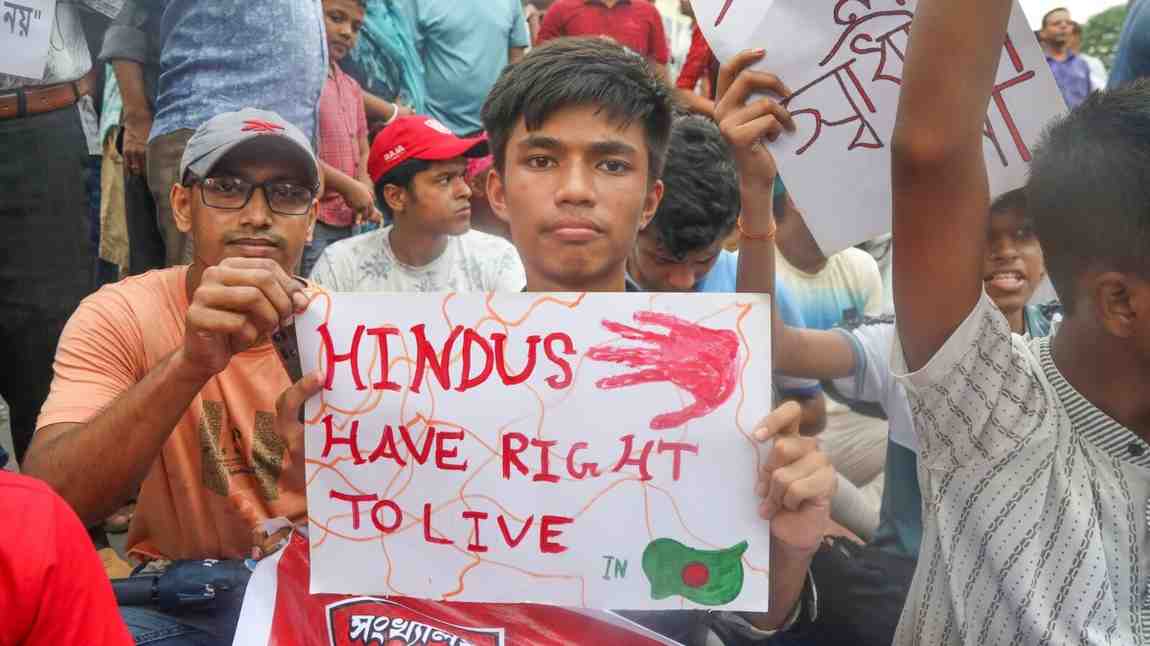
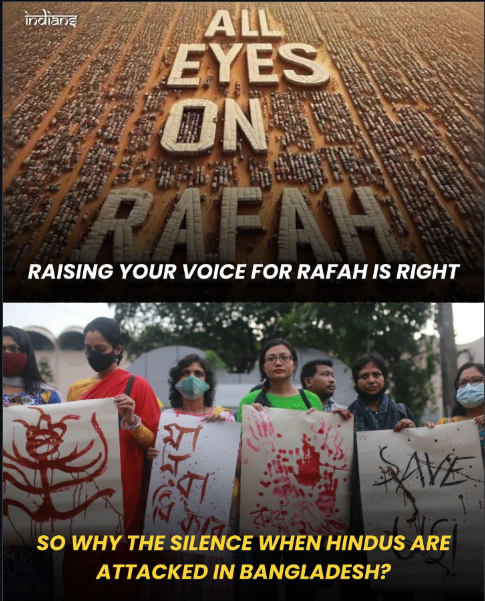
When the world chants “All Eyes on Gaza,” it reveals how quickly global conscience can mobilize. Protests erupt, timelines flood with solidarity, and international institutions speak in unison.
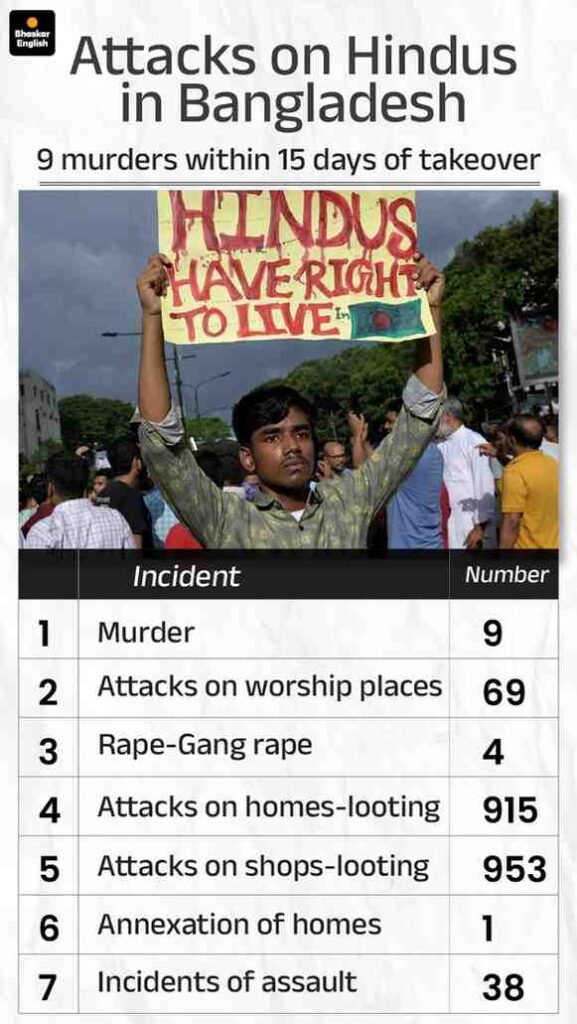
But when Hindus are attacked, displaced, or killed in Bangladesh, the silence is deafening.
No hashtags.
No candle marches.
No emergency UN sessions.
So the question must be asked—why are there no eyes on Bangladeshi Hindus?
Hindus in Bangladesh: A Shrinking Minority No One Talks About
Hindus are the largest religious minority in Bangladesh, yet their numbers have been steadily declining for decades.
- In 1947, Hindus made up over 22% of East Pakistan (now Bangladesh)
- Today, they account for roughly 7–8% of the population
This decline is not due to low birth rates. It is driven by:
- targeted violence
- forced migration
- land seizures under discriminatory laws
- periodic communal riots
- intimidation during elections and political unrest
Every major wave of violence sees Hindu families crossing borders into India, often quietly, often permanently. Their displacement rarely becomes international news.
Bangladesh Is Not an Isolated Case: The Pakistan Pattern
The same pattern is visible across the border in Pakistan.
- Hindus formed 15–20% of Pakistan’s population at independence
- Today, they are below 2%
Forced conversions, temple desecration, abductions, and systemic discrimination are well-documented by human rights groups. Yet these stories struggle to break into global discourse unless framed through geopolitics rather than human suffering.
The Loud Lie: “Minorities Are Under Attack in India”
At the same time, a dominant global narrative insists that minorities in India are under existential threat.
But the numbers tell a different story.
- Muslim population in India has grown from ~9% in 1951 to over 14% today
- Christian population has remained stable
- Sikh, Buddhist, and Jain communities continue to exist with legal protections
- Minority institutions run schools, colleges, and charities across the country
India’s minorities have constitutional safeguards, political representation, and demographic growth—something Hindus in Bangladesh and Pakistan cannot claim.
This does not mean India is perfect. But it does mean the comparison is dishonest.
The Hypocrisy of Global Liberal Outrage
This is where the contradiction becomes uncomfortable.
Global liberal activism claims to stand for:
- minority rights
- freedom of religion
- protection from ethnic violence
Yet:
- Hindu suffering does not trend
- attacks on temples are ignored
- killings are dismissed as “local tensions”
- demographic erasure is treated as a footnote
Why?
Because acknowledging Hindu persecution disrupts a preferred narrative—one where Hindus are always the majority aggressors and never the victims.
Victimhood, it seems, is selective.
Media Silence Is Not Neutral — It Is Political
When violence against Hindus is underreported, it sends a message:
- some lives are more newsworthy than others
- some minorities deserve protection, others deserve silence
- outrage depends on ideology, not injustice
This silence does not reduce violence. It enables it.
Why This Conversation Matters
This is not about competing tragedies.
It is about consistency.
If the world can mobilize for one minority under threat, it must be willing to do the same for another—regardless of religion, region, or political convenience.
Human rights are not a brand campaign.
They are not a hashtag strategy.
And they cannot be applied selectively.
Final Thoughts
There are eyes on Gaza.
There are eyes on Ukraine.
There are eyes on many global conflicts.
But when it comes to Bangladeshi Hindus, the world looks away.
And silence, in the face of persecution, is not neutrality—it is complicity.
About the Author
Genzews Editorial Team covers global geopolitics, economic trends, and technology. The team focuses on data-driven analysis and simplifying complex global developments for readers.



1 thought on “No Eyes on Bangladeshi Hindus While the World Protests”